
Post Harvest & Food Security
Post harvest losses can drastically impact food security. UPL’s post-harvest solutions have been saving thousands of tonnes of food from destruction globally and are recognized amongst the most effective.
Please fill in the details below:
Post harvest losses can drastically impact food security. UPL’s post-harvest solutions have been saving thousands of tonnes of food from destruction globally and are recognized amongst the most effective.
UPL is determined to reduce food loss caused by pests, diseases and improper storage practices. UPL QUICKPHOS™ is a potent fumigant. The active ingredient of UPL MAGNAPHOS™ is an ammonia-free formulation utilising a fast-gas release action. UPL QuickPHlo-R™ is ideal for state-of-the-art application technologies patented in most countries. UPL’s Decco is the only player with a global presence providing a complete range of fruit coating products, storage solutions, services and equipment.
Cereal crops and roots crops account for about 30% and 20% post harvest losses respectively. UPL provides simple, effective and safe solutions to protect grains and change this reality.
UPL QUICKPHOS, coupled with its principal ingredient Aluminium Phosphide, is a solid potent fumigant in tablet, pellet and bag presentation. QUICKPHOS may be used for the fumigation of raw agricultural commodities, animal feed and feed ingredients, processed foods and certain other nonfood items.
UPL MAGNAPHOS’ active ingredient comprises of Magnesium Phosphide with a palate of its ammonia-free formulation. Fast-gas release is its most popular presentation. It’s a versatile fumigant for use on stored raw agricultural commodities, processed foods, animal feed and feed ingredients..
UPL system QuickPHlo-R is ideal in state-of-the-art application technologies and is under patent in most countries.
45% of all fruit and vegetables are thrown away. UPL’s Decco with its range of specialty fruit coatings and storage products provides solutions for increasing shelf life. It also prevents damage during packaging and transportation. In several countries, Decco has also developed equipment solutions with teams of mechanical representatives available to assist you with your packing needs.

High quality coatings for postharvest use on






After harvest, grain spoils due to several factors such as excessive moisture, mold and insects. Until now, farmers, co-ops and grain elevators have relied on manual inspections or temperature cables to manage this problem. But these solutions are complex, time-consuming, expensive, and outdated. TeleSense is here to change that.
By combining our sensors with data science capabilities, we simplify grain quality management in storage. Our sensors continuously capture temperature, relative humidity (RH) and CO2 levels and transmit the data to our software (TeleSense app). By using advanced analytics to generate customer specific insights, we can help answer key storage related questions such as: how to improve grain storage-life, how to reduce spoilage, when to turn fans on/off, and when to sell.
Originally designed for monitoring grain, TeleSense offers products for a variety of grain storage types. By analyzing information such as current grain conditions and local weather, we provide specific actions to manage grain quality. Currently, we offer three grain-related features: grain conditioning for aerated bins/silos, CO2-based spoilage detection for bins/silos and risk zone detection for piles/bunkers.
Potatoes must be kept within a precise temperature and RH range to minimize chances of sprouting or decay. TeleSense monitors the air as it enters and exits the potato storage, thereby developing a complete view of the storage unit. With continuous monitoring and earlier issue detection, we help potato storage managers reduce their risk of spoilage and improve profitability.
Seeds require specific storage conditions to preserve their germination capacity. TeleSense products make it possible to continuously monitor storage conditions and provide valuable insights to maintain required quality.
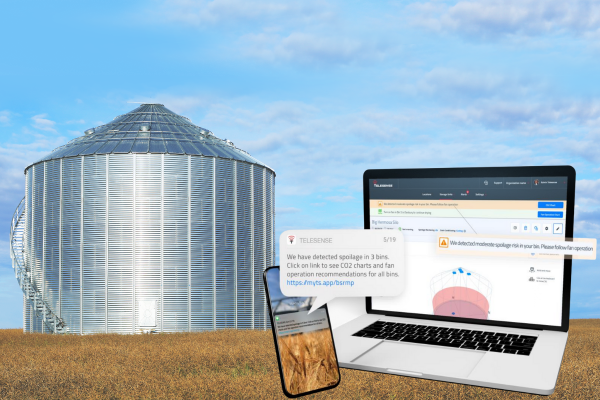
Grain Bin Monitoring
TeleSense offers a cable-free option to remotely monitor aerated grain bins/silos. Instead of hanging expensive temperature cables from reinforced bin roofs, we install two Spider devices, one at the top of the bin and one at the bottom. Using temperature, relative humidity (RH) and CO2 data received from Spiders, TeleSense provides guidance for fan operation and grain quality management.
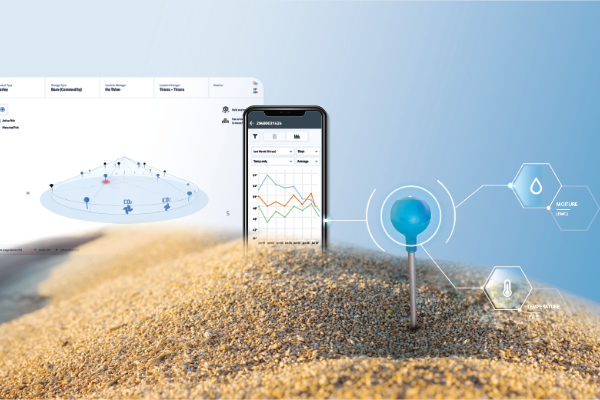
Ground Pile and Bunker Monitoring
When piling your grain, you might be concerned about spoilage due to high temperature, excessive moisture or other quality compromising situations. Instead of relying on difficult-to-install temperature cables or manual probing, why not use our simple solution? TeleSense offers battery-powered multi-sensor spears which are laid out in a grid across the top of your pile/bunker to collect grain temperature and relative humidity (RH) data. By comparing the temperature and RH values of air as it travels between sensors, we develop an understanding of what’s happening throughout the grain mass.
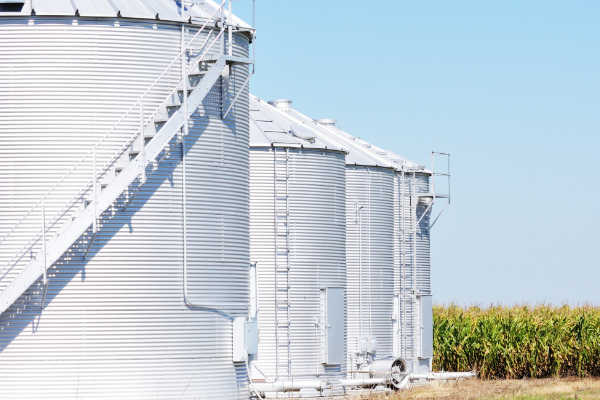
Temperature Cable Upgrade
Are you tired of manually checking your bin temperature cables? We have something that can help. Attach the TeleSense Wireless Junction Box (WJB) to your existing temperature cables (Rolfes@Boone, TSGC) to enable remote monitoring. Once the TeleSense WJB is installed, you can check on all your bins in one place using the TeleSense App, get access to historical temperature charts and set custom alerts for high or low temperature conditions.

Monitoring in Transport
Are you looking for a way to check on your commodities (corn, potatoes, wheat, etc.) during transit? TeleSense offers standalone, battery-powered spears for monitoring. These spears collect data on temperature, relative humidity (RH) and geographical location, and directly send it to the TeleSense App via a cellular connection. Using our system, you can receive alerts when temperature or RH levels exceed your pre-set range. Moreover, you can easily compare all modes of transportation being monitored on a single platform.

Other Storage Units
No matter how you store your grain, TeleSense has a monitoring solution for you. Our battery-powered spears include multiple temperature and relative humidity (RH) sensors and provide the perfect way to continuously monitor your storage units. All device data is available for easy remote access via the TeleSense App.
We serve all types of storage units, including but not limited to:-
Grain Bags
Crates
Flat Storages (warehouses, sheds, etc.)
The goal of post-harvest science is to maintain all the texture, flavour, appearance and healthiness of produce for as long as is necessary. We are constantly striving to improve our formulations, products and equipment services and invest substantial R&D resources. In our produce rooms we simulate all type of conditions that may exist in packing and storage areas to validate our results.
Decco FullCover is an innovative electrostatic application system that permits the application of very low volumes of fruit coatings. It ensures that fruit sensitive to water based coatings, such as kiwis, avocados, berries and plums, can be treated to extend the commercial life, reducing the cost of wastage and increasing the profitability of each harvest.
Decco NaturCover is a formula that contains a base of natural extracts that protects fruit against dehydration and maintains its natural appearance for a long time. It is the ideal coating to maintain the healthy appearance of fruit and the firmness of its pulp. It is expected to be certified shortly for use on organic crops.
Decco ArcAqua is a patented technology for the release of ozone in water based solutions. It is an essential tool to ensure food safety in packing houses.
Guide to Best Post Harvest Practices
When it comes to harvesting crops, attention needs to be paid at all stages of crop production right from the sowing the seeds, providing the right nutrition to the crops, post-harvest measures, to selling the produce at the distribution centres.
What is Post-harvest?
Post-harvest refers to the activities after harvest that ensures the preservation of commodities in terms of safety, quality and quantity. This would include handling, storage and transportation of agricultural commodities.
Post-harvest has to be completed in a defined time-frame since the crop starts deteriorating post-separation from the parent plant. This stage of crop production is vital since the final quality of the product, whether it is for direct consumption or being used as a raw material for processed foods, depends on it.
There are leading players in the post-harvest solutions space like Decco that ensure no compromise in crop quality by using high-grade coatings, fungicides, growth regulators, sanitizers, and anti-scald. Decco also provides equipment solutions for packing in some countries.
Services provided by Decco include residue analysis, fungicide residue monitoring, weight loss studies, and tank concentrations. Decco has a team of technical experts in post-harvest methods. Additional services you can expect from Decco are spore trials, IPM programs, and resistance management.
Importance of Food Security and Grain Storage
There is a direct connection between post-harvest management and food security. When there are post-harvest losses due to mismanagement, you have food loss and wastage, leading to lower food security. This results in a chain reaction with an adverse effect on farmer's incomes since they lose a sizeable percentage of their yield due to degradation of quality. Farmers with small landholdings are the worst affected, suffering changes in their livelihood as they are unable to meet the needs of their families.
Mismanagement during post-harvest also produces low-quality crops due to mould, insects, and debris. These contaminants pose a danger to consumers due to the presence of substances like aflatoxin and ochratoxin.
There are two types of storage methods, temporary and long-term. Temporary storage yields the best results when the grain is kept post the drying period. The three types of temporary storage methods are aerial storage, ground or drying-floor based storage, and open timber platforms.
Long-term storage methods include storage baskets or cribs, calabashes or earthenware pots, clay jars, solid wall bins or silos made of mud or clay, and underground storage pits. Storage baskets or cribs are used in humid countries. Underground storage pits are found in the drier regions of India, Turkey and parts of Africa.
The best grain storage solution in developing countries is metal silos. Metal silos protect crops from storage insect pests. These are made from galvanized iron sheets and have hermetic sealing making these storage solutions airtight.
A roadblock for widespread usage of metal silos in developing countries is high procurement costs, leading to food grains stored in temporary alternatives like cover and plinth or leasing warehouses. It is also important to decentralize storage and use a PPP model for creating storage facilities through the BOT or build operate transfer basis. With private sector participation, there would be higher competition and lower storage costs.
There are hermetic storage bags that are long-term solutions and don't require fumigants. These bags have ultraviolet resistant PVC membranes that are airtight and provide protection against light. The grains get a natural and unpolluted environment.
Fumigants are gas-based pesticides used for pest control. Post-harvest solution providers like Decco have potent fumigants containing aluminium phosphide pest control in animal feed, raw agricultural products and processed foods.
The process of using fumigants to protect crops from pests is known as fumigation. Pests account for a major part of post-harvest losses.
Some fumigants that are ammonia-free formulations ensure fast-gas release. With the advancement in technology, atmospheric gases are replacing man-made gases for controlled atmosphere treatments organically. The preferred atmospheric gas for stored products and grains is carbon dioxide, though they are now being used for fresh commodities as well. For this reason, carbon dioxide comes under the category of natural or organic fumigants.
DISCLAIMER
“UPL and its subsidiaries have made every attempt to ensure accuracy of the information provided on this website. However, this is a global webpage with access to different geographies for wider reach and greater awareness of UPL. In the course of doing the same, UPL has used Weglot translator plugin to cover the language of this website from English to select regional languages.
UPL therefore, does not accept any responsibility or liability on the nature, standard or the accuracy of the translation and cannot take responsibility for any type of inaccurate contextual meaning in the event of a mismatch from English to a regional language.”