Please fill in the details below:

Thank you for getting in touch with us.

We will get back to you shortly.

Occupational Health and Safety (OHS)

At UPL, the safety and wellbeing of our workers are paramount. We have robust systems in place to monitor and evaluate employee health and safety. Regular health inspections and audits help us identify and address any potential risks or hazards in the workplace. We continuously strive to enhance safety measures and conduct regular training sessions on various topics, including behavioural and operational aspects, to ensure our workers are equipped with the knowledge and skills to always prioritise safety.

“Safety First – Always & Every time” is the motto of our company, consistent with our commitment to Sustainability as safety is the foundation of a sustainable enterprise. As an enterprise, we are responsible for adhering to the goal of Zero Harm for our Permanent and contractual employees as also to ensure safe operations in all the geographies and communities we operate in.

We have developed an Occupational, Health, and Safety (OHS) policy that complies with all the requirements related to occupational health, safety, and environmental standards. Our OHS policy extends its coverage to all our permanent and contractual employees and our suppliers worldwide.

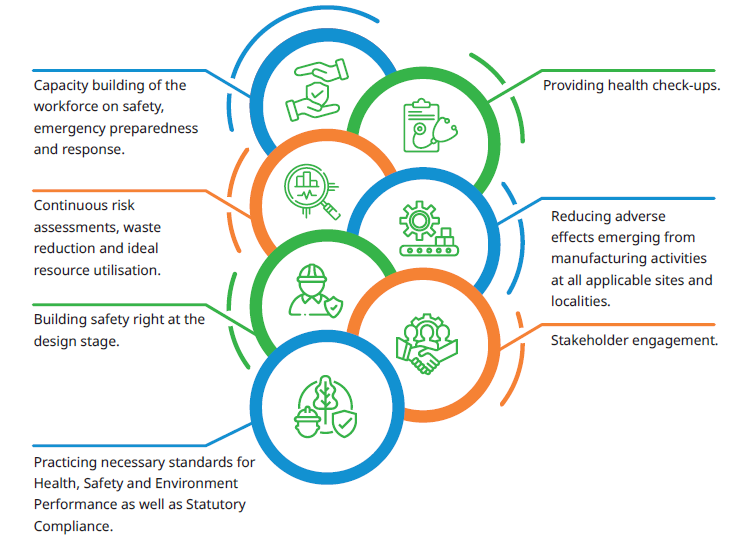
UPL’s Occupational Health and Safety (OHS) :- UPL's OHS policy Objectives of our HSE Policy

UPL OHS Activities

UPL maintains structured emergency preparedness and response systems to manage potential operational and process-related emergencies. Emergency response plans are developed based on operational risks, regulatory requirements and local emergency scenarios. Trained Emergency Response Teams (ERTs), fire safety systems, first-aid arrangements, mock drills, communication systems and coordination with external emergency agencies support effective emergency preparedness and response.

Organized Committees

UPL promotes worker participation in safety through structured safety committees, plant safety representatives, site consultation forums and other employee engagement mechanisms.Employees and workers participate through gate meetings, toolbox talks, safety campaigns, incident-learning sessions and safety discussions.

Safety Committees
Plant Safety
Representatives
Site Consultation
Forums
Safety Audit Team

UPL conducts safety audits and inspections as part of its ongoing approach to hazard identification, risk control and compliance. Safety performance is monitored through internal audits, inspections, Gemba observations and other structured assessments.

Transporters Meet

The company is arranging periodic transporter meet & also arranging training for transport crew, thus ensuring safety during transportation of hazardous chemicals.

Safety Training

UPL conducts structured HSE training to strengthen safety awareness, technical capabilities and emergency preparedness across its workforce.

Training programmes cover areas such as:

Induction Process Safety Permit-to-Work Emergency Response Contractor Safety Refresher and Awareness Training

During FY 2025–26, safety capability building included 11,063+ HSE training hours and more than 200 job-specific safety sessions.

In-house training to all employees

UPL conducts in-house safety training for employees and workers to strengthen awareness, technical capabilities and safe working practices. Training is supported through induction programmes, process safety training, Permit-to-Work training, emergency response training, contractor safety programmes and refresher and awareness sessions.

Process Hazard Analysis

UPL follows a structured process safety approach to identify, assess and control hazards associated with processes and operations. These practices help ensure that process safety risks are identified and appropriately controlled throughout the lifecycle of operations.

Process safety practices include:

  • Hazard and Operability Studies (HAZOP) for new projects and process modifications
  • Preliminary Layer of Protection Analysis (LOPA) for highly hazardous processes
  • Process Hazard Analysis (PHA)
  • Pre-Startup Safety Reviews (PSSR)
  • Digital Change Management System
  • Bow-Tie studies for critical risks
  • Identification and auditing of critical safety barriers
ERTs

UPL maintains Emergency Response Teams (ERTs) at all sites to strengthen preparedness and response capabilities across its operations.

ERTs are supported through emergency response training, firefighting training, first-aid training and regular emergency drills. Emergency preparedness is tested through mock drills and readiness assessments, with corrective actions tracked to closure.

2025 -26 Highlights of ERTs:

1,264 Employees and workers trained in emergency response 58 Emergency drills conducted 851 Firefighting team members trained 737 First-aiders trained 100% Emergency response actions closed

UPL has an Environment Response Team(ERT) at every unit.

Committee

UPL's safety governance is supported by Board and senior leadership oversight, Corporate HSE leadership, site leadership, functional safety teams, occupational health teams and worker and contractor representatives. Safety committees and worker representatives provide a structured mechanism for employee participation, enabling workers to raise concerns, share feedback and contribute to safety improvement initiatives.

UPL also monitors HSE performance through established governance reviews, audits, inspections, incident reporting and corrective actions.

Certifications

ISO
FTSE4G00D Logo ISO 9001 Logo ISO 14001 Logo ISO 45001 Logo

UPL is a certified logo holder of International Certifications (FTSE4GOOD, ISO 14001, Responsible Care, ISO 9001) for demonstrating strong environmental, social and governance practices. 91% of production from our manufacturing sites is certified under ISO14001 and ISO45001 standards.

Responsible Care Committed Company Responsible Care Logo

Responsible Care is a global, voluntary initiative developed autonomously by the chemical industry for the benefit of the chemical industry. This initiative runs across 52 countries accounting for nearly 90% of the global chemical production. UPL is a recognized Responsible Care Company, awarded the use of its logo. We voluntarily adopted the practice codes of the Responsible Care (RC) initiative accepted by Indian Chemical Manufacturers’ Association and implemented the ISO 45001-2018. Responsible Care demonstrates our commitment towards continuous HSE performance improvement.

Safety Management & Practices at Manufacturing Sites

- Health, Safety and Environment remain a high priority across UPL's manufacturing operations.

- Our approach focuses on proactive risk identification, process safety, workforce capability building, incident learning and continuous improvement.

- We use structured tools and practices including HIRA, JSA, HAZOP, Permit-to-Work systems, safety audits, Gemba observations, Pre-Startup Safety Reviews and incident-learning mechanisms to identify and control risks.

- UPL also encourages employees and workers to report hazards and unsafe conditions without fear.

- Safety observations, near-miss reporting, incident investigations and corrective and preventive actions help strengthen controls and prevent recurrence.

- Digitalisation is further enabling real-time monitoring, compliance and proactive risk management across operations.

Stewardship

Environmental Online Parameters

Source: UPL Sustainability Report 2025-26.pdf

DISCLAIMER

“UPL and its subsidiaries have made every attempt to ensure accuracy of the information provided on this website. However, this is a global webpage with access to different geographies for wider reach and greater awareness of UPL. In the course of doing the same, UPL has used Weglot translator plugin to cover the language of this website from English to select regional languages.

UPL therefore, does not accept any responsibility or liability on the nature, standard or the accuracy of the translation and cannot take responsibility for any type of inaccurate contextual meaning in the event of a mismatch from English to a regional language.”