Please fill in the details below:
Agriculture provides livelihood to more than 58% of India’s Population, contributing about 18% to our GDP, yet the sector has yet to undergo radical digital transformation. Most farmers still practise traditional methods of cultivation owing to a lack of awareness, education, low accessibility to mechanisation, and poor access to technology.
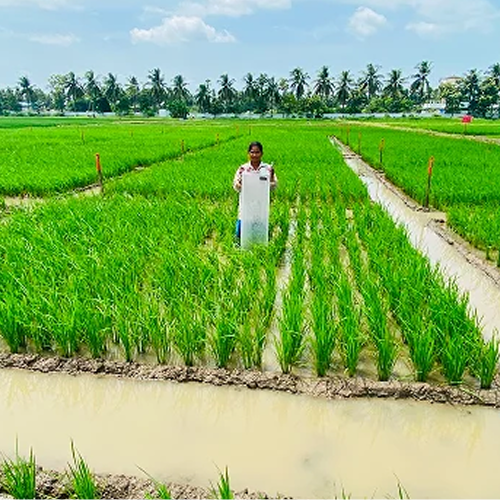
Alternate Wetting and Drying (AWD) is an improved rice water-management technique where irrigation is applied only after the field water level drops below a defined threshold, rather than continuous flooding. Field water status is monitored using perforated PVC AWD tubes, installed in the soil to measure subsurface water depth and soil moisture conditions. Irrigation is typically applied when the water level inside the tube falls to -15 cm below the soil surface. This controlled drying suppresses anaerobic conditions, thereby significantly reducing methane emissions.
AWD also improves water-use efficiency while maintaining yield, making it a scientifically proven practice for low-emission rice
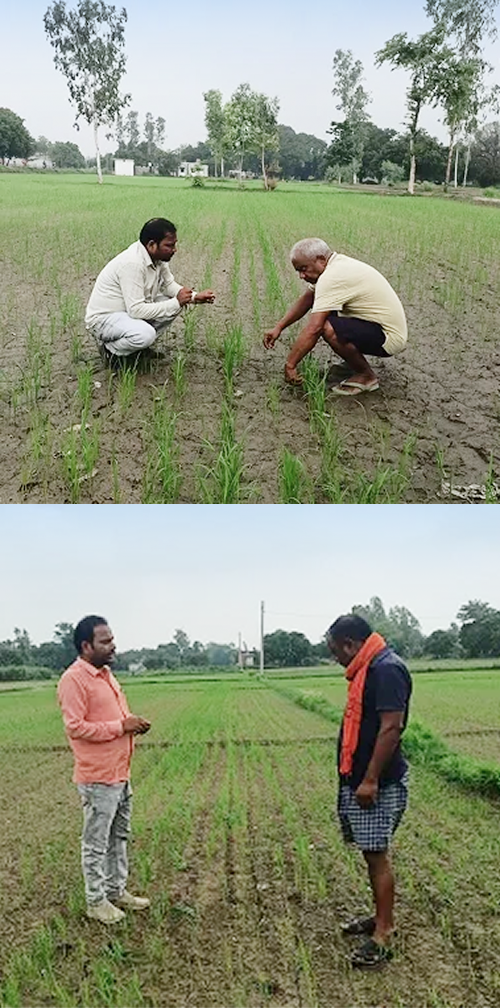
The Direct Seeded Rice (DSR) Program is an advanced rice cultivation system where seeds are sown directly into the field using precision seed drills, eliminating the need for nursery raising and puddled transplanting. This practice significantly reduces water use, energy consumption, and labor requirements while enabling timely crop establishment. DSR improves soil structure by avoiding repeated puddling and supports better root development. It also lowers methane emissions by minimizing prolonged flooded conditions during early crop stages.
Along with these scientific interventions, these programs also focuses on farm implementation of below interventions to ensure rice productivity remains intact while we achieve the GHG emission reduction:
Seed, soil, water, nutrition & trash management practices
Integrated seed to harvest crop care and nutrition
End-to-end digital tracking and advisory
Transparent pricing with exclusive offers
nurture.farm has its own state of art facility of Gas Chromatographer to quantify the GHG samples collected from the rice fields from different geographies across India which is helpful for measuring the emissions reductions in Carbon Credit programs under different methodologies of Global registries.
A small step towards sustainability. One giant leap for mankind.
DISCLAIMER
“UPL and its subsidiaries have made every attempt to ensure accuracy of the information provided on this website. However, this is a global webpage with access to different geographies for wider reach and greater awareness of UPL. In the course of doing the same, UPL has used Weglot translator plugin to cover the language of this website from English to select regional languages.
UPL therefore, does not accept any responsibility or liability on the nature, standard or the accuracy of the translation and cannot take responsibility for any type of inaccurate contextual meaning in the event of a mismatch from English to a regional language.”